
By Jocelyn Zeng, Founder of JoinedPuzzles
A few months ago, in a bioethics seminar, my professor brought up "digital phenotyping," using wearables and phones to track things like heart rate, sleep, and movement over time. I asked how it applied to autism care, half expecting a vague answer. Instead, I learned wearables can pick up signs of distress in autistic kids before anyone around them can see it, sometimes by a full minute.

Me and Jessica at dinner the day before I flew to college
If you read my previous post, cartoons became a shared language between me and Jessica. Watching her face told me a lot. But there's a layer of what's happening inside her body that I can't see just by looking, and that might be exactly where the most useful information is hiding.
The Body Has Its Own Weather Report
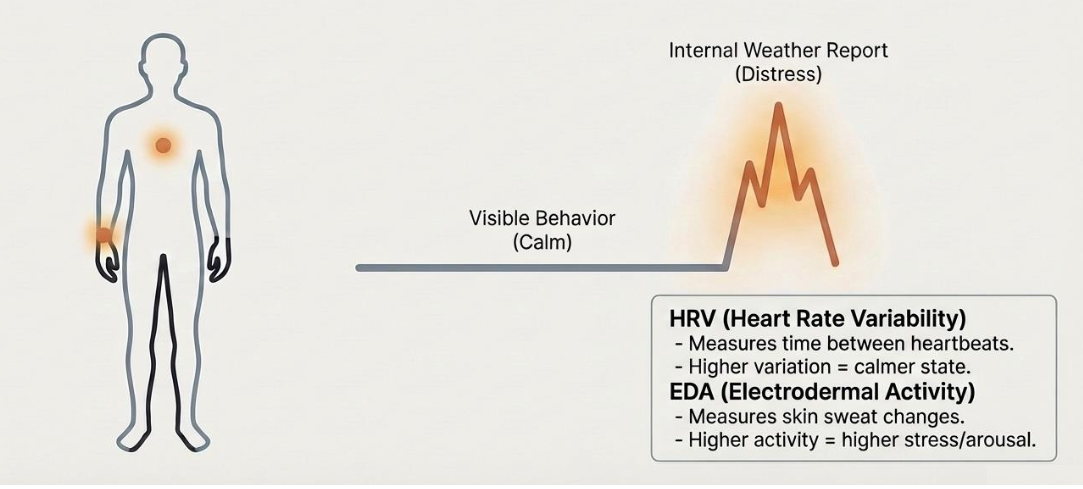
Your autonomic nervous system (the part controlling heart rate, sweat response) constantly broadcasts stress signals, even when your face looks calm. Researchers track this through heart rate variability and electrodermal activity, tiny sweat-related skin changes.
For a lot of autistic kids, this gap between what you can see and what's happening internally is bigger. Jessica can look fine right up until she isn't. The research I found also made a point that stuck with me: a personal baseline matters more than a population average. The goal isn't measuring Jessica against "normal." It's learning what's normal for Jessica, so a device notices when she drifts from her own baseline.
A 60-Second Warning
The stat that jumped at me: one study found wearables predicted aggressive behavior in autistic psychiatric inpatients about 60 seconds before it happened, using physiological spikes alone (Imbiriba et al., 2023). Sixty seconds isn't much, but if you've ever been in the room right before a meltdown, even a few seconds of warning matters.
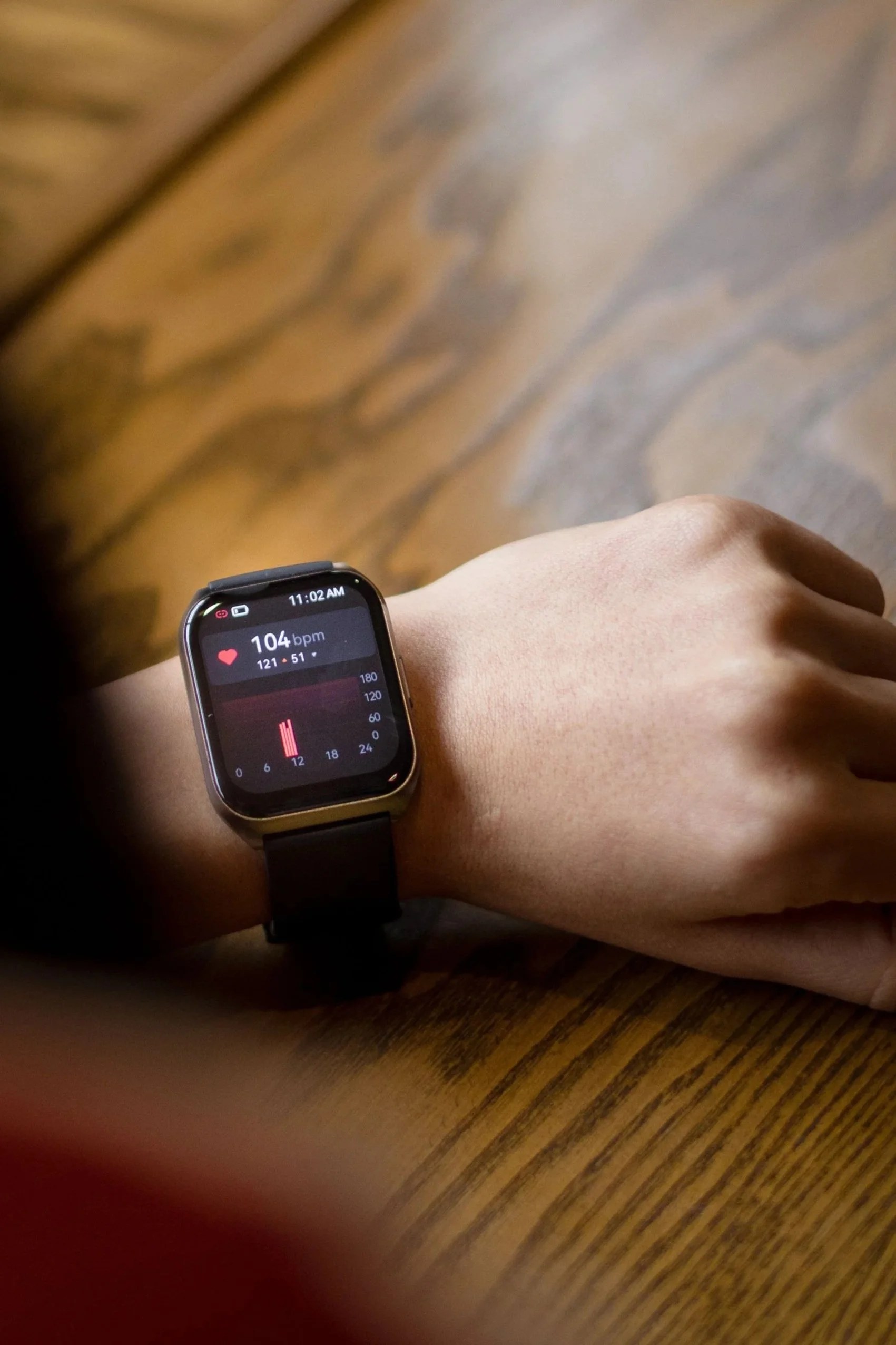
Other researchers found wearables can distinguish ordinary movement from the motion patterns of a challenging behavioral episode, with real accuracy (Bahrami Rad et al., 2025). None of this is perfect, accuracy hovers in the 70-90% range, and a lot of it comes from clinical settings, not someone's actual living room. Still, the core idea landed: physical signals might translate what's happening inside someone more directly than facial expression or words ever could.
Full disclosure: I haven't actually tried any of this with Jessica. This is all research and reading, not something I've put on her wrist and watched happen. I don't know how she'd feel about being monitored this way. Which is why the next part matters.
But Here's Where I Got Stuck
The more I read, the more excited I got, until I hit a wall I ended up writing my ethics paper about.
If you put a wearable on a child and record their heart rate, sleep, and stress every day for years, you're building a permanent record of their most vulnerable moments, one they never agreed to and won't be old enough to weigh in on for years, if ever. A parent can legally consent on their child's behalf. But the kid whose data it is doesn't get a say. What starts as a protective tool could later feel like surveillance to the person who was actually monitored.
There's a higher risk too. Research on "anonymized" datasets shows people can sometimes be re-identified once separate datasets are combined (Narayanan & Shmatikov, 2008). Daily routines and physiological patterns can work like a fingerprint. If that data ever connected to something like an insurance database, it's not hard to imagine it being misused.
What I Think Actually Helps
I don't think the answer is to stop building this. A 60-second warning during Jessica's hardest moments is real, and I don't want to talk myself out of caring about that. But the safeguards matter as much as the sensors:
Milestone re-authorization: instead of treating a parent's initial consent as permanent, check back in once the person is old enough to decide for themselves.
Data expiration: sensitive data shouldn't sit in a database forever by default. Delete or anonymize it on a real timeline, not "just in case."
Independent data trusts: an outside organization, not the company selling the wearable, decides how sensitive data actually gets used.
None of these fully resolve the tension. But they treat the kid being monitored as someone who will grow into a person with their own opinion about their own data, not just a subject of their parents' intentions forever.
Where This Leaves Me
I wanted to write about how cool this science is, and I still think it is. But I can't write about it without sitting in the uncomfortable part too: helping someone and monitoring someone can look identical from the outside, and the difference usually comes down to consent, which gets complicated fast when the person involved is a kid who can't fully voice their thoughts yet.
If Jessica were old enough to read and understand this, I'd want to ask her what she thinks, not just decide for her. That feels like the actual point.

Me and Jessica at Half Moon Bay in early June 2026
Sources referenced: Torous et al. (2017); Narayanan & Shmatikov (2008); Imbiriba et al. (2023), JAMA Network Open; Bahrami Rad et al. (2025), Physiological Measurement; Kaye et al. (2015); Balkin (2016); Wendler (2006).